
What is Mathematics and Should We Trust It?
Exploring the philosophical origins of mathematics

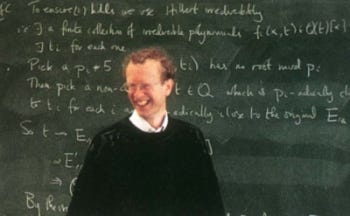
Mathematics is a fundamental and bounded concept in our world, but we don’t know where it originated. A common philosophical question is, “Was mathematics invented or discovered?” “Where is mathematics rooted?” “How far can mathematics take us?” These are very relevant and crucial questions, but we still do not have the answers to them.
Every mathematician and physicist thought that every problem could be proven by mathematics until Gödel’s incompleteness theorems; now, there is a sudden realization that not every mathematical theorem has a proof, not every mathematical problem has a solution, and there are still mathematical concepts that may forever elude our comprehension.
We have made huge leaps in mathematics. We have seen Andrew Wiles provide a proof for Fermat’s Last Theorem, which eluded mathematicians for decades; we have seen Grigori Perelman solve the Poincaré Conjecture, which seemed like a problem that was forever going to be a stain on mathematicians’ garments. We have seen mathematicians make intuitive leaps in knowledge, and we have some of the greatest mathematicians currently living in current times, with the likes of Terence Tao, and we still hope to see massive leaps in knowledge by future generations of mathematicians. We have relied on the concepts and ideas of mathematics for generations, and that would likely never end, but we forget some things.
We hope to find more proofs, theorems, conjectures, and concepts. There are still a multitude of problems up for grabs, such as the P vs NP Conjecture, which has eluded mathematicians and computer scientists for years. This conjecture has a Clay Prize medal attached to it, and we have a multitude of researchers working on it. Some researchers have spent their whole life on this problem and passed away without solving it. We aim to find a mathematical solution to everything, but we keep forgetting some things.
Kurt Gödel found a flaw in mathematics in his thesis. Isn’t anyone worried whether there are other flaws in mathematics? Great thinkers comment and proudly say that mathematics reflects reality. What if that is a lie? What if mathematics is just a construct we have created to explain phenomena? If Gödel found a flaw in mathematics, there is a likely chance there are a multitude of flaws yet to be discovered that we may never find and understand.
Mathematicians spend their whole life working on mathematical problems. They solve some problems; they never solve some problems. What if there are problems that aren’t meant to be solved? And we are just chasing & hunting glories that bear no seed? We don’t even know where mathematics originated from. How do we know if we can trust it? Are there significant flaws in mathematics that we haven’t discovered, and we aren’t even considering discovering?
These are very intriguing and speculative questions we need to ask about the nature of mathematics. Mathematics is robust yet compact, advanced yet simple, a paradoxical tapestry woven from the threads of logic and imagination. We love it and we hate it; it explains phenomena so simply, but we claim that only the brightest minds can grasp it. As we delve deeper into the nature of mathematics, we find ourselves at the crossroads of philosophy and science, grappling with significant questions due to the inquisitive and fundamental nature of the simple concepts which lay the foundations of modern mathematics.
The debate of whether mathematics was invented or discovered is a profound one, rooted in the very essence of human cognition and the universe’s structure. We may never ever know the true origin of mathematics, but due to the curious nature of human existence, we would forever ask these questions. If mathematics is invented, it is a product of the human mind and the genius of the creation which is humans. This perspective suggests that mathematics is a language we have created to articulate and make sense of the patterns and structures we observe in the world around us.
On the other hand, if mathematics is discovered, it implies that mathematical truths exist independently of human minds, and mathematics is just a journey of discovery which might elude us forever. This view aligns with the core Platonic idea of an abstract, mathematical reality that transcends physical existence. In this realm, concepts like numbers, geometric forms, and their relationships have an objective existence, separate from our awareness of them, and we are just creatures dancing with the fundamental cores of mathematics.
The implications of Gödel’s Incompleteness Theorems are profound, humbling, and also very philosophical. These discoveries were the most important insights which any mathematician or logician has provided us. They remind us that mathematics, like any human endeavor, is subject to limitations and sometimes these limitations are yet to be discovered and may elude us forever. Gödel showed that in any sufficiently complex mathematical system, there are propositions that cannot be proven or disproven within the system itself. This revelation shattered the dream of finding a complete and consistent set of axioms for all of mathematics, underscoring the inherent incompleteness and potential fallibility of our mathematical structures.
Yet, the beauty and power of mathematics cannot be understated. Throughout history, mathematics has not only been a tool for solving practical problems but also a means of elevating human thought to the abstract realms of beauty and truth. The achievements of mathematicians like Andrew Wiles and Grigori Perelman, and living legends like Terence Tao, highlight the human capacity for intellectual triumph. They remind us that, despite its limitations, mathematics can lead us to profound insights about the universe.
The ongoing quest to solve great problems, like the P vs NP Conjecture, reflects the enduring allure and challenge of mathematics. These problems, while immensely difficult, stimulate innovation, creativity, and a deeper understanding of the world. They represent the uncharted territories of mathematical knowledge, beckoning the brave and the curious.
Yet, as we celebrate these triumphs and continue our quest, we must also embrace the humility and introspection brought forth by Gödel’s revelations. We should ponder the philosophical implications of mathematics, questioning its origins, its relationship with reality, and its ultimate limitations. What if there are aspects of reality that mathematics cannot capture? What if there are truths that lie beyond the reach of our mathematical tools?
In this journey of exploration and discovery, we must also recognize the inherent uncertainty and imperfection in our pursuit. Not all mathematical problems may have solutions, and some truths may forever lie beyond our grasp. This realization is not a call for despair but a reminder that there are limits to our understanding of the universe.
As we stand on the shoulders of giants, we must be aware that those giants were not invincible, and we must carefully tread along their paths, as we look into the vast echoes of mathematical unknowns, it is crucial to note that we are trying to create finite understanding of a universe that is infinite. The pursuit of mathematical knowledge is not just a quest for solutions and proofs, but a continuous philosophical journey towards discovery. Whether mathematics is a creation of the human mind or a discovery of universal truths, it remains a cornerstone of our understanding of the universe. But the main question is to always understand that in this infinite construct in which we are living, there are limitations to any science or pattern which we discover, and we have to keep that in mind as we keep exploring mathematics and its limitations.